by Erica Bauermeister
I read and enjoyed Bauermeister's The School of Essential Ingredients about a year ago, so I thought I'd read her next book. The Lost Art of Mixing is nice, but there is nothing that stands out about it. I wanted this book to be better.
I love food writing, and food writing isn't easy. There are only so many ways you can say "delicious." Bauermeister has to rely heavily on metaphor, some of which are lovely, while others are too forced and fall flat. Her writing reminds me of Joanne Harris (Chocolat, The Girl With No Shadow, Five Quarters of the Orange), but without the elements of mystery and magic. Also, Bauermeister's books aren't as good as Harris's.
That being said, the further you get into this book, the clearer it becomes that this book really isn't about food. The School of Essential Ingredients was, and there is occasional references to food in this book, but it feels like Bauermeister tried to force food into a story where it doesn't belong.
Bauermeister's characters are stereotypical: the troubled nearly twenty-year-old with boy problems; the successful restauranteur finding herself unexpectedly and inconveniently pregnant; the wife who assumes her husband is having an affair because she only has half of the facts; the woman slowly slipping into senility and her family and friends who have to cope. Everything in this book is connected; everything is a metaphor or a coincidence, each character trait or professional choice is indicative of things to come, and there is always some kind of lesson. It's heavy-handed.
The Lost Art of Mixing is a nice read. A nice summer read. It's a book that feels as familiar as a well-used cookbook: you follow the tried-and-true formula, and you know what you'll get. But the end result is pleasantly, reliably recognizable (and a little bland) (and cloying).
Monday, June 24, 2013
Thursday, June 13, 2013
We Learn Nothing
by Tim Kreider

I learned of this book from two podcasts, "Radiolab" and "Love, Sex, Death, and Books." After hearing Kreider talk about his essays, I put We Learn Nothing on the top of my list of books to read.
Kreider's essays are about love, friendship, loss, and a fear of being rejected. He expresses frustration and anxiety about not knowing; you can only know your friendships and relationships from your point of view. Kreider struggles with inexplicable, and explicable, losses of friendship. While Kreider claims, "I've demonstrated an impressive resilience in the face of valuable life lessons, and the main thing I seem to have learned from this one [being stabbed] is that I am capable of learning nothing from almost any experience, no matter how profound," ultimately, I think this is untrue. Kreider has learned something. It may seem like nothing, but, if nothing else, in each of his anecdotes, Kreider continues to learn about himself, and presents his evidence to the reader.
I don't want to describe this book with phrases like "universal truths" or "gems," but Kreider's book is full of them. Behind Kreider's humor and sarcasm are surprisingly poignant truisms. While Kreider's essays are his personal observations and anecdotes, they are relatable. He conveys feelings through his writing, not just circumstances. Reading "How They Tried to Fuck Me Over (But I Showed Them!)" was like looking into a mirror, at times. I may be an anger addict. Kreider writes, "If you're anything like me, you spend about 87 percent of your mental life winning imaginary arguments that are never actually going to take place." I'm still confronting high school bullies in my head, and it's surprisingly satisfying! Until I realize that I'm only confronting memories of people who aren't in the room.
Each of Kreider's essays contain halting moments. Moments where I needed to read the sentence again, and paused, with a reaction of "huh." In the opening "Reprieve," Kreider concludes saying, "I don't know why we take our worst moods so much more seriously than our best, crediting depression with more clarity than euphoria." Huh.
Not all of Kreider's essays are "gems.""Escape from Pony Island," for instance, tends to drag. But "The Czar's Daughter" and "Sister World" are beautifully thoughtful and touching, and aren't without their moments of cynicism and self-deprecation, which you being to expect and love of Kreider's writing. Kreider isn't afraid of portraying himself on the page as unlikable. And for that, he becomes increasingly likable.
We Learn Nothing is well worth reading. Kreider's writing balances humor (the essays are even punctuated by Kreider's cartoons), melancholia, and sarcasm with his truisms, without being preachy. In the end, Kreider isn't out to teach us anything. And why would he be if he hasn't been able to learn anything from his own life? But there is a lot to take away from Kreider's book. If nothing else, this book will make you stop and think, "huh."
I learned of this book from two podcasts, "Radiolab" and "Love, Sex, Death, and Books." After hearing Kreider talk about his essays, I put We Learn Nothing on the top of my list of books to read.
Kreider's essays are about love, friendship, loss, and a fear of being rejected. He expresses frustration and anxiety about not knowing; you can only know your friendships and relationships from your point of view. Kreider struggles with inexplicable, and explicable, losses of friendship. While Kreider claims, "I've demonstrated an impressive resilience in the face of valuable life lessons, and the main thing I seem to have learned from this one [being stabbed] is that I am capable of learning nothing from almost any experience, no matter how profound," ultimately, I think this is untrue. Kreider has learned something. It may seem like nothing, but, if nothing else, in each of his anecdotes, Kreider continues to learn about himself, and presents his evidence to the reader.
I don't want to describe this book with phrases like "universal truths" or "gems," but Kreider's book is full of them. Behind Kreider's humor and sarcasm are surprisingly poignant truisms. While Kreider's essays are his personal observations and anecdotes, they are relatable. He conveys feelings through his writing, not just circumstances. Reading "How They Tried to Fuck Me Over (But I Showed Them!)" was like looking into a mirror, at times. I may be an anger addict. Kreider writes, "If you're anything like me, you spend about 87 percent of your mental life winning imaginary arguments that are never actually going to take place." I'm still confronting high school bullies in my head, and it's surprisingly satisfying! Until I realize that I'm only confronting memories of people who aren't in the room.
Each of Kreider's essays contain halting moments. Moments where I needed to read the sentence again, and paused, with a reaction of "huh." In the opening "Reprieve," Kreider concludes saying, "I don't know why we take our worst moods so much more seriously than our best, crediting depression with more clarity than euphoria." Huh.
Not all of Kreider's essays are "gems.""Escape from Pony Island," for instance, tends to drag. But "The Czar's Daughter" and "Sister World" are beautifully thoughtful and touching, and aren't without their moments of cynicism and self-deprecation, which you being to expect and love of Kreider's writing. Kreider isn't afraid of portraying himself on the page as unlikable. And for that, he becomes increasingly likable.
We Learn Nothing is well worth reading. Kreider's writing balances humor (the essays are even punctuated by Kreider's cartoons), melancholia, and sarcasm with his truisms, without being preachy. In the end, Kreider isn't out to teach us anything. And why would he be if he hasn't been able to learn anything from his own life? But there is a lot to take away from Kreider's book. If nothing else, this book will make you stop and think, "huh."
Tuesday, May 21, 2013
Let's Pretend This Never Happened
(A Mostly True Memoir)
by Jenny Lawon
This is my first staff pick at the bookstore!
I love love love this book. It's quirky, funny, heartbreaking, honest, and shameless. I am a big fan of Jenny Lawson and her blog. I think everyone should read this book (as long as you aren't offended by lots of profanity, inappropriate humor (of the highest caliber), and lots of awkward moments). It's not everyone's cup of tea, but it is so worth the read.
Sunday, July 15, 2012
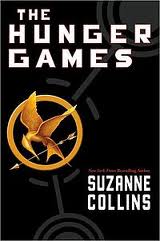
The Hunger Games
by Suzanne Collins
I love love love this book. Too bad I waited until the movie and all the hype started to get on board. But it's excellent; I sped through the whole thing in less than two days. This truly is the definition of a book that's too good to put down.
Now, ok, it's "young adult lit," sure. Yes the teenage romance is a little tedious. I'm tired of teenage girls who are amazing and talented and beautiful, but don't realize they're amazing and talented and beautiful until she has two equally amazing, talented, and beautiful men fighting over her. Plus, the book being young adult lit, the reader is lead by the hand to certain, small epiphanies, whether plot or character related. As the reader, you have to do very little work. But what is great about Katniss is how strong she is. My hope is that The Hunger Games franchise can eclipse (ha ha) the whole Twilight phenomenon, and girls will aspire to be Katnisses rather than Bellas.
The Hunger Games is like nothing I've read. However, it does read a little like Harry Potter and the Goblet of Fire with children fighting in these incredible, demanding challenges, mixed with Shirley Jackson's short story "The Lottery." But The Hunger Games is in a league of it's own. It's violent and fast-paced, and I cried much more than I expected. These characters are easy to become attached to and a generally admirable. The lines between good and evil are fairly clear-cut, as you would expect, but not to a comical degree.
Now, I know what's coming next, Katniss is going to fight the Capitol, and I'm not sure I want that. Part of me wishes this were the only book and not a trilogy. I want to believe people inhabit this insane, brutal world and that's it. But that wouldn't be very redeeming and not quite as "young adult lit" appropriate. So I'll press on with Catching Fire. But my feeling is that The Hunger Games will end up being my favorite of the three.
I love love love this book. Too bad I waited until the movie and all the hype started to get on board. But it's excellent; I sped through the whole thing in less than two days. This truly is the definition of a book that's too good to put down.
Now, ok, it's "young adult lit," sure. Yes the teenage romance is a little tedious. I'm tired of teenage girls who are amazing and talented and beautiful, but don't realize they're amazing and talented and beautiful until she has two equally amazing, talented, and beautiful men fighting over her. Plus, the book being young adult lit, the reader is lead by the hand to certain, small epiphanies, whether plot or character related. As the reader, you have to do very little work. But what is great about Katniss is how strong she is. My hope is that The Hunger Games franchise can eclipse (ha ha) the whole Twilight phenomenon, and girls will aspire to be Katnisses rather than Bellas.
The Hunger Games is like nothing I've read. However, it does read a little like Harry Potter and the Goblet of Fire with children fighting in these incredible, demanding challenges, mixed with Shirley Jackson's short story "The Lottery." But The Hunger Games is in a league of it's own. It's violent and fast-paced, and I cried much more than I expected. These characters are easy to become attached to and a generally admirable. The lines between good and evil are fairly clear-cut, as you would expect, but not to a comical degree.
Now, I know what's coming next, Katniss is going to fight the Capitol, and I'm not sure I want that. Part of me wishes this were the only book and not a trilogy. I want to believe people inhabit this insane, brutal world and that's it. But that wouldn't be very redeeming and not quite as "young adult lit" appropriate. So I'll press on with Catching Fire. But my feeling is that The Hunger Games will end up being my favorite of the three.
Monday, July 9, 2012
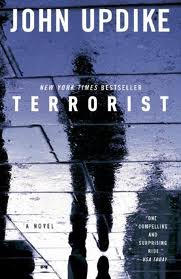
Terrorist
by John Updike
When discussing this book with a friend who didn't care for it, she said something along the lines of 'He's clearly racist." But I'm not sure this is true. The characters in Updike's novels are frequently described in stereotypical terms, but to me, that seems to be the point. Updike does this to force the reader to confront these descriptions they may or may not have thought or believe themselves, and he does it universally, not just for Ahmad or Tylenol. After all,
Everyone's a little bit racist; it's true.
But everyone is just about as racist as you!
If we all could just admit
That we are racist, a little bit,
And everyone stop being so PC,
Maybe we could live in Harmony!
~ Avenue Q
However, that being said, I don't know how authentic Updike's characters are. Part of me feels like he bought into the terrifying propaganda going around after 9/11 that every Muslim in the Islamic community was plotting against the infidels (a word I really hate). In this way, I have to admit, the book does come across as racist. And I don't know much about Islam, but Terrorist does paint is a something to be afraid of, a religion that True Believers are willing to die for, in a very active, aggressive and terrifying way, taking out as many "unbelievers" as possible. Maybe Updike is just perpetuating stereotypes rather than presenting them as something to be confronted and questioned. I'd prefer to think that's not what he's doing, that he's going beyond that, but perhaps not. Maybe Updike is a racist.
The novel itself is not an easy read; I struggled through the very slow first 50 or so pages. And, in general, Terrorist is a very slow-moving novel. If you're looking for a plot-driven novel this is not it, Terrorist is character-driven. The only real action happens in the last 70 pages. I enjoy that it's character-driven, but being that the characters are based on stereotypes, I don't particularly like this book.
Overall, I have mixed feelings about Terrorist. I did get caught up in Ahmad's development and his involvement with Excellency Home Furnishings and the imam and the scheme to blow up the Lincoln tunnel, but, again, all of that feels stereotypical in a damaging way, buying into the 9/11 terror propaganda. I'd like to think that Ahmad becomes friends with Mr. Levy, goes to college, and lives happily ever after with Joryleen, but the ending isn't that redemptive. It's. . . a little disappointing, and I don't recommend reading this book.
Friday, June 22, 2012
People of the Book
by Geraldine Brooks
I'm surprised I hadn't read this book sooner. I remember seeing it come and go at the library where I worked, but I never picked it up. I assumed it was a book about religion and missionaries and conversions - a poor assumption. I wish I had taken the time to read the back cover. This time I did pick it up because it was on the staff recommendation shelf (a feature at libraries I happen to really appreciate). (Thanks whoever Meagan is!)
This book is a fascinating, often heartbreaking, historical mystery surrounding the Sarajevo Haggadah, filled with fantastic, brave-faced women, as well as men. Being a book about a Jewish text, the book does deal a lot with religion and religious conflict (so my initial assumptions weren't completely off-base). I had no idea that there was such a long history of antisemitism. People have been unable to get along and killing one another over religious differences for centuries, I just didn't know the specifics of it. But perhaps even more striking is the protective relationships between Muslims and Jews, which is carried throughout the centuries in this novel. The stories of personal struggle and reluctant bravery in the face of death as a result of religious persecution are incredible. Each character struggles with their own religion/religious identity in the face of society-at-large. Brooks is an excellent storyteller and creates a cohesive story from fragments of history, all found in the Sarajevo Haggadah by art conservator Hanna Heath.
On a related note, is book binding still an art? Conservators must still be in demand for the World's ancient texts; but does the world still have craftsman book binders? In the world of self-published ebooks, it feels like it's probably an ancient and near-lost, if not entirely lost, art. I understand the need for progress, but I don't want to live in a world of self-published ebooks. I want authors with editors and agents and publishers and real book binders (although, I don't know that I ever have lived in that world.). I suppose, on the one hand, it's an impractical art, but I wonder if it is still practiced. It must be, somewhere.
One small editorial issue I have with this book is the chapters. The book begins with numbered chapters and abandons them for sections. Why bother to have chapters at all?
I loved being taken through the pages of history by Hanna and her curiosity and skill. Her own personal story of strength and change sits nicely within that of the haggadah. I recommend this book for anyone interested in history, the art of the book, religion, travel, or resilient characters.
I'm surprised I hadn't read this book sooner. I remember seeing it come and go at the library where I worked, but I never picked it up. I assumed it was a book about religion and missionaries and conversions - a poor assumption. I wish I had taken the time to read the back cover. This time I did pick it up because it was on the staff recommendation shelf (a feature at libraries I happen to really appreciate). (Thanks whoever Meagan is!)
This book is a fascinating, often heartbreaking, historical mystery surrounding the Sarajevo Haggadah, filled with fantastic, brave-faced women, as well as men. Being a book about a Jewish text, the book does deal a lot with religion and religious conflict (so my initial assumptions weren't completely off-base). I had no idea that there was such a long history of antisemitism. People have been unable to get along and killing one another over religious differences for centuries, I just didn't know the specifics of it. But perhaps even more striking is the protective relationships between Muslims and Jews, which is carried throughout the centuries in this novel. The stories of personal struggle and reluctant bravery in the face of death as a result of religious persecution are incredible. Each character struggles with their own religion/religious identity in the face of society-at-large. Brooks is an excellent storyteller and creates a cohesive story from fragments of history, all found in the Sarajevo Haggadah by art conservator Hanna Heath.
On a related note, is book binding still an art? Conservators must still be in demand for the World's ancient texts; but does the world still have craftsman book binders? In the world of self-published ebooks, it feels like it's probably an ancient and near-lost, if not entirely lost, art. I understand the need for progress, but I don't want to live in a world of self-published ebooks. I want authors with editors and agents and publishers and real book binders (although, I don't know that I ever have lived in that world.). I suppose, on the one hand, it's an impractical art, but I wonder if it is still practiced. It must be, somewhere.
One small editorial issue I have with this book is the chapters. The book begins with numbered chapters and abandons them for sections. Why bother to have chapters at all?
I loved being taken through the pages of history by Hanna and her curiosity and skill. Her own personal story of strength and change sits nicely within that of the haggadah. I recommend this book for anyone interested in history, the art of the book, religion, travel, or resilient characters.
Thursday, May 31, 2012
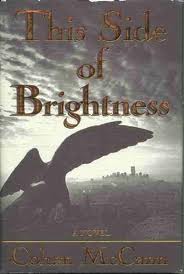
This Side of Brightness
by Colum McCann
I was first introduced to Colum McCann via my contemporary Irish fiction course; we read Let the Great World Spin. McCann is a skilled and vivid writer, and he is very much a New York writer, as opposed to an Irish writer, despite being Irish. The beauty is in the details. McCann writes about what is unique and easily overlooked about New York.
The premise of This Side of Brightness is fascinating: tunnel people. The novel follows the lives of those who built the subway tunnels and those who inhabit them. I did have a little difficulty with the initial chapters because it was difficult for me to visualize, not only the process of digging the tunnels but the navigation of the tunnels and nests and cubby holes.
But I completely love this book; I couldn't put it down. McCann's characters felt real and true, and I didn't expect to get so invested in Treefrog. His underground world is amazing. I also enjoy when the characters in a novel are gradually shown to be intertwined, I feel like your brought along on the journey and develop with the characters. The ending of the novel is a little walking-off-into-the-sunset, but I can forgive that because I'm not sure there would be abetter way to end the novel. I highly, highly recommend reading This Side of Brightness, it is the perfect balance of love, heartache, danger, and true humanity.
I was first introduced to Colum McCann via my contemporary Irish fiction course; we read Let the Great World Spin. McCann is a skilled and vivid writer, and he is very much a New York writer, as opposed to an Irish writer, despite being Irish. The beauty is in the details. McCann writes about what is unique and easily overlooked about New York.
The premise of This Side of Brightness is fascinating: tunnel people. The novel follows the lives of those who built the subway tunnels and those who inhabit them. I did have a little difficulty with the initial chapters because it was difficult for me to visualize, not only the process of digging the tunnels but the navigation of the tunnels and nests and cubby holes.
But I completely love this book; I couldn't put it down. McCann's characters felt real and true, and I didn't expect to get so invested in Treefrog. His underground world is amazing. I also enjoy when the characters in a novel are gradually shown to be intertwined, I feel like your brought along on the journey and develop with the characters. The ending of the novel is a little walking-off-into-the-sunset, but I can forgive that because I'm not sure there would be abetter way to end the novel. I highly, highly recommend reading This Side of Brightness, it is the perfect balance of love, heartache, danger, and true humanity.
Subscribe to:
Comments (Atom)